
The Problem and Our Solution
The "Show Me X to Y" Challenge
Leadership asks: "Can you show me how data flows from our CRM system through to the quarterly reports?"
What typically happens:
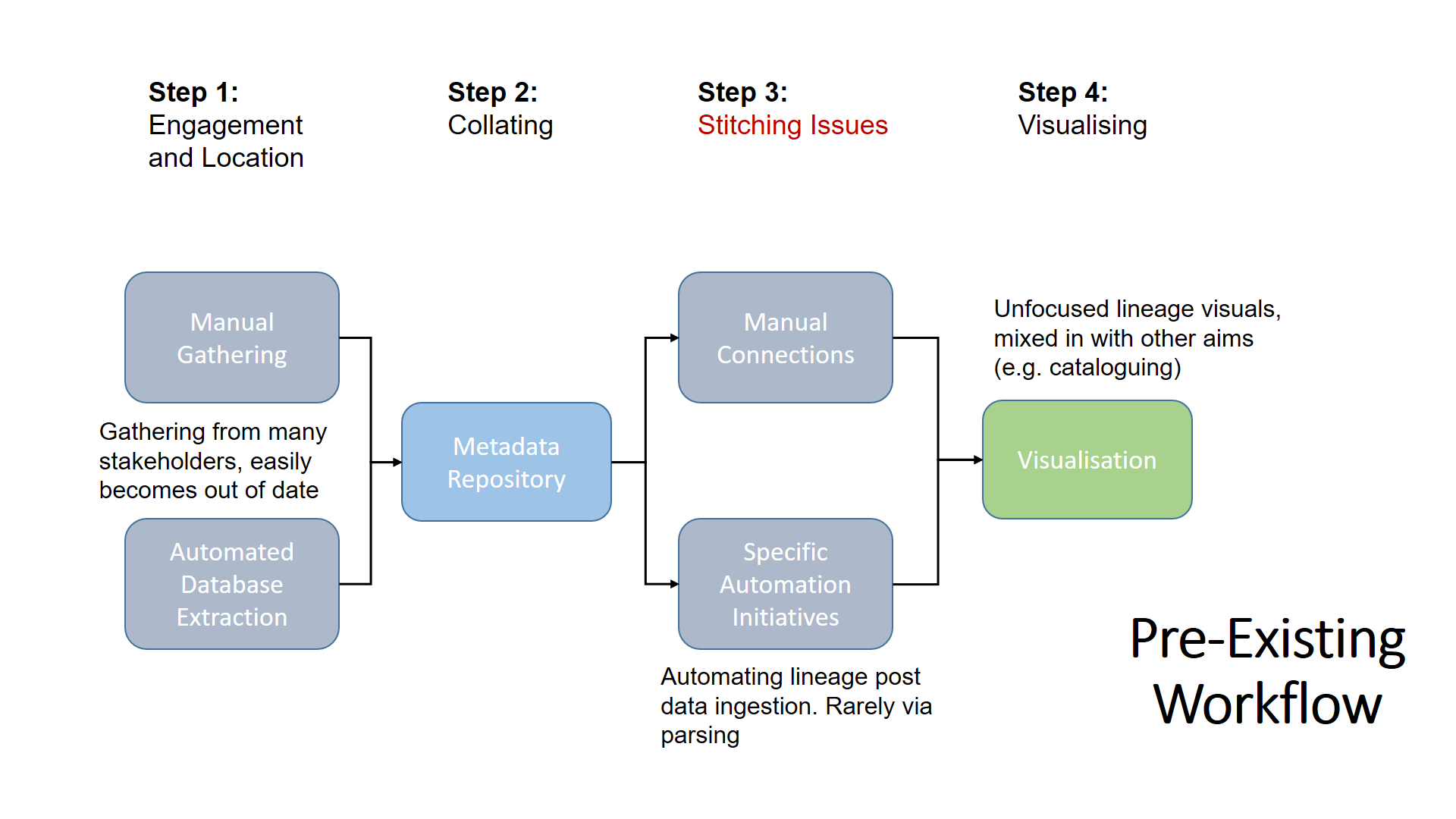
- Weeks of Manual Work: Data teams work to trace connections through SQL scripts, ETL jobs, and transformation code
- Incomplete Answers: Existing tools show lineage within systems but break at integration points
- Limited Solutions: Teams gather all source metadata and all target metadata into a catalogue with no connections, delivering limited value
- Delayed Progress: Projects slow, stakeholders need more information, and clear answers remain elusive
The issue isn't the tools; it's that traditional approaches focus on cataloguing everything rather than understanding the connections between systems.
Focus on the Joints, Not the Catalogue
Mesoura Metadata is desktop software that reads your transformation code and shows you exactly how data flows between systems:
- Reads Your Code: Upload SQL and Python transformation scripts; the software automatically extracts lineage from your actual transformation logic
- Standardises Metadata: Converts code from different languages into a unified metadata structure that shows clear connections
- Interactive Visualisation: Explore data flow through physics-based node graphs; drag, zoom, and trace connections instantly
- Always Current: Re-upload updated scripts anytime to see how lineage changes, with no manual documentation maintenance
- Purpose-Built Views: See upstream dependencies for data quality, highlight critical data elements for compliance, identify redundant transformation steps for efficiency
When you focus on the joints between systems, you get the answers leadership actually needs.
How It Works
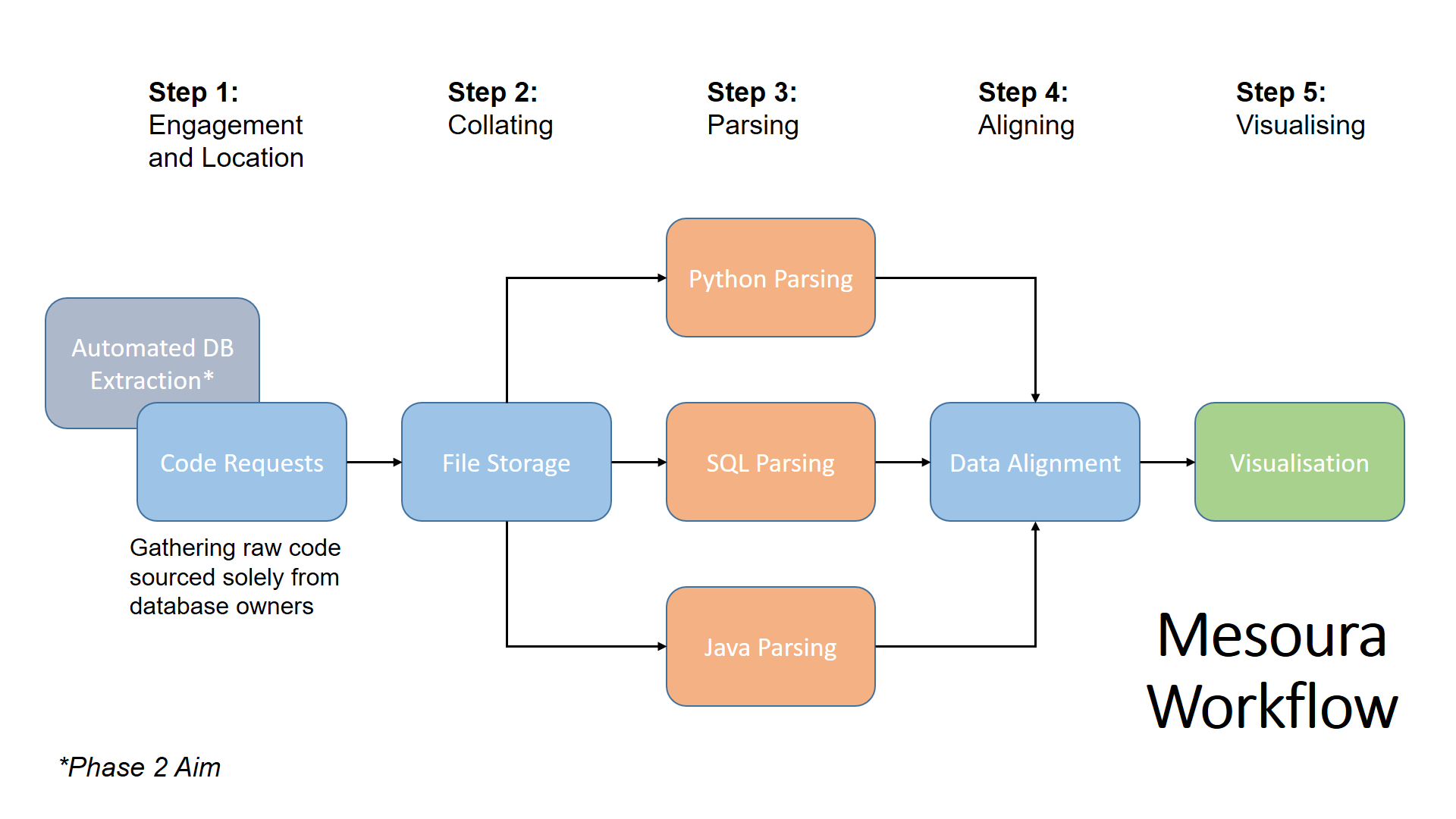
Mesoura Metadata's workflow transforms raw code into visual data lineage in five steps:
1. Locating
Upload your code files directly to the platform. Mesoura accepts SQL scripts and Python files containing data transformations.
2. Collating
Files are organised and stored securely. The system prepares for parsing by categorising code by language and identifying transformation patterns.
3. Parsing
This is where the magic happens. Our parsers analyse SQL queries and Python DataFrame operations to extract transformation logic. Unlike traditional approaches, parsing happens automatically; no manual interpretation required.
4. Aligning
Parsed transformations are aligned into a coherent data lineage structure. Column-level connections are mapped, transformation types are identified, and relationships between tables and DataFrames are established.
5. Visualising
View your data lineage through an interactive, physics-based node graph. Click nodes to explore column details, trace transformation paths, and understand exactly how data flows through your systems.
Interactive Demo
Explore how Mesoura Metadata visualises column-level data transformations. Toggle between SQL and Python scenarios to see how different code types are parsed and displayed. Each node represents a column, and arrows show transformations between columns. Hover over edges to see transformation details, and drag nodes to explore relationships. Use scroll to zoom in/out.
Interactive physics-based graph. Hover over edges to see transformation details. Dashed lines = context connections (e.g., GROUP BY).
-- Create transformed orders table with concatenated customer summary
CREATE TABLE transformed_orders AS
SELECT
    order_id,
    CONCAT(customer_name, '  ', DATE_FORMAT(order_date, '%Y-%m-%d'))
        AS customer_order_summary,
    quantity,
    CAST(price AS FLOAT) AS price_float
FROM orders;

-- Create summary with aggregations
CREATE TABLE order_summary AS
SELECT
    order_id,
    SUM(quantity) AS total_quantity,
    SUM(price_float) AS total_revenue
FROM transformed_orders
GROUP BY order_id;
# Load data from Snowflake
df = pd.DataFrame(data, columns=columns)

# Data Transformation
df['salary'] = df['salary'].astype(int)
df['hire_date'] = pd.to_datetime(df['hire_date'])

# Concatenate first and last name
df['full_name'] = df['first_name'] + ' ' + df['last_name']

# Add seniority level based on salary
def determine_seniority(salary):
    if salary < 50000:
        return "Junior"
    elif 50000 <= salary < 100000:
        return "Mid"
    else:
        return "Senior"

df['seniority_level'] = df['salary'].apply(determine_seniority)

# Group by department and calculate metrics
grouped_df = df.groupby('department').agg({'salary': 'mean', 'email': 'count'}).reset_index()
grouped_df.rename(columns={'salary': 'avg_salary', 'email': 'employee_count'}, inplace=True)

# Identify duplicate names
df['name_duplicate_count'] = df.groupby('full_name')['full_name'].transform('count')
What We Visualise
Mesoura Metadata helps you answer critical questions about how data flows between your systems:
Data Lineage
Complete end-to-end visibility of how data moves through your systems. Track from source extraction through transformations to final outputs.
Column-Level Tracking
Understand transformations at the column level, not just tables. See exactly which source columns contribute to each target column.
Transformation Logic
View the actual transformation operations"â€Âjoins, aggregations, filters, calculations"â€Âextracted directly from your code.
Impact Analysis
Click any node to see upstream sources and downstream dependencies. Understand the impact of changes before you make them.
Multi-Language Support
Parse SQL, Python, and Java transformations in a unified view. No matter your tech stack, Mesoura understands your code.
Always Current
Re-parse your code whenever it changes. Your lineage visualisation stays synchronized with your actual transformation logic.
Use Cases
Regulatory Defense and Compliance
Scenario: A financial services firm faces an audit and needs to demonstrate data lineage for customer data used in regulatory reports. Manual documentation is incomplete and stakeholders cannot easily answer "where does this number come from?"
Solution: Upload transformation code to Mesoura Metadata. The software reads the code and shows exactly where sensitive data originates, how it's transformed, and where it flows. Generate documentation showing complete lineage for auditors.
Result: Answer auditor questions in minutes with defensible, code-backed documentation. Demonstrate clear data lineage and control understanding to satisfy audit requirements.
Data Quality Remediation
Scenario: A business intelligence team discovers incorrect revenue figures in dashboards. They need to trace the error back through multiple transformation layers to find the root cause, but existing lineage tools only show connections within each database.
Solution: Upload the transformation scripts that connect source systems to the dashboard. Mesoura Metadata shows the complete path from raw data through each transformation step, revealing where the calculation error occurred.
Result: Identify root causes in hours instead of weeks. Fix the underlying issue rather than patching symptoms. Prevent similar errors by understanding transformation dependencies.
Operational Efficiency
Scenario: A data engineering team suspects their pipeline has redundant transformation steps; data being copied between systems unnecessarily, creating maintenance burden and performance issues.
Solution: Visualize the complete data flow across systems. Identify intermediate databases that simply pass data through without meaningful transformation, or data duplicated across three systems when two would suffice.
Result: Eliminate unnecessary transformation steps, reduce infrastructure costs, and simplify maintenance. Free up engineering time by removing redundant pipeline components.
Metadata Resources
Learn more about data lineage challenges and how Mesoura Metadata addresses them:
Video: Understanding the Stitching Problem
Watch this explanation of why traditional metadata management struggles with the stitching problem and how automated parsing provides the solution.
Blog Posts
Read detailed articles about metadata management and data lineage:
Standardised Metadata Model
Learn more about my approach to ideal metadata modelling:
Key Features
- Reads Your Code Automatically: Upload SQL and Python transformation scripts, no configuration required
- Standardises Metadata: Converts transformation logic into unified metadata structure showing clear system connections
- Column-Level Detail: See exactly which source columns feed which target columns through each transformation
- Interactive Visualisation: Physics-based node graph; drag, zoom, hover to explore data flow between systems
- Purpose-Built Views: Upstream dependencies for DQ, critical data element highlighting for compliance, redundancy identification for efficiency
- Impact Analysis: Click any node to see what feeds it and what depends on it
- Export Documentation: Generate lineage snapshots for audit documentation and stakeholder presentations
- Desktop Software: Your code stays on your machine, no cloud uploads required
- Always Current: Re-upload updated scripts anytime to refresh lineage visualisation
Ready to Get Started?
Schedule a demo or request pricing information to see how Mesoura Metadata can eliminate stitching problems and provide automated, accurate data lineage.